



Rubber plant
Ficus elastica · Moraceae · Leafy green plant
Also called Rubber tree, Rubber fig
Water when the top few centimetres are dry and wipe the large leaves to keep them free of dust. The milky sap can irritate skin.
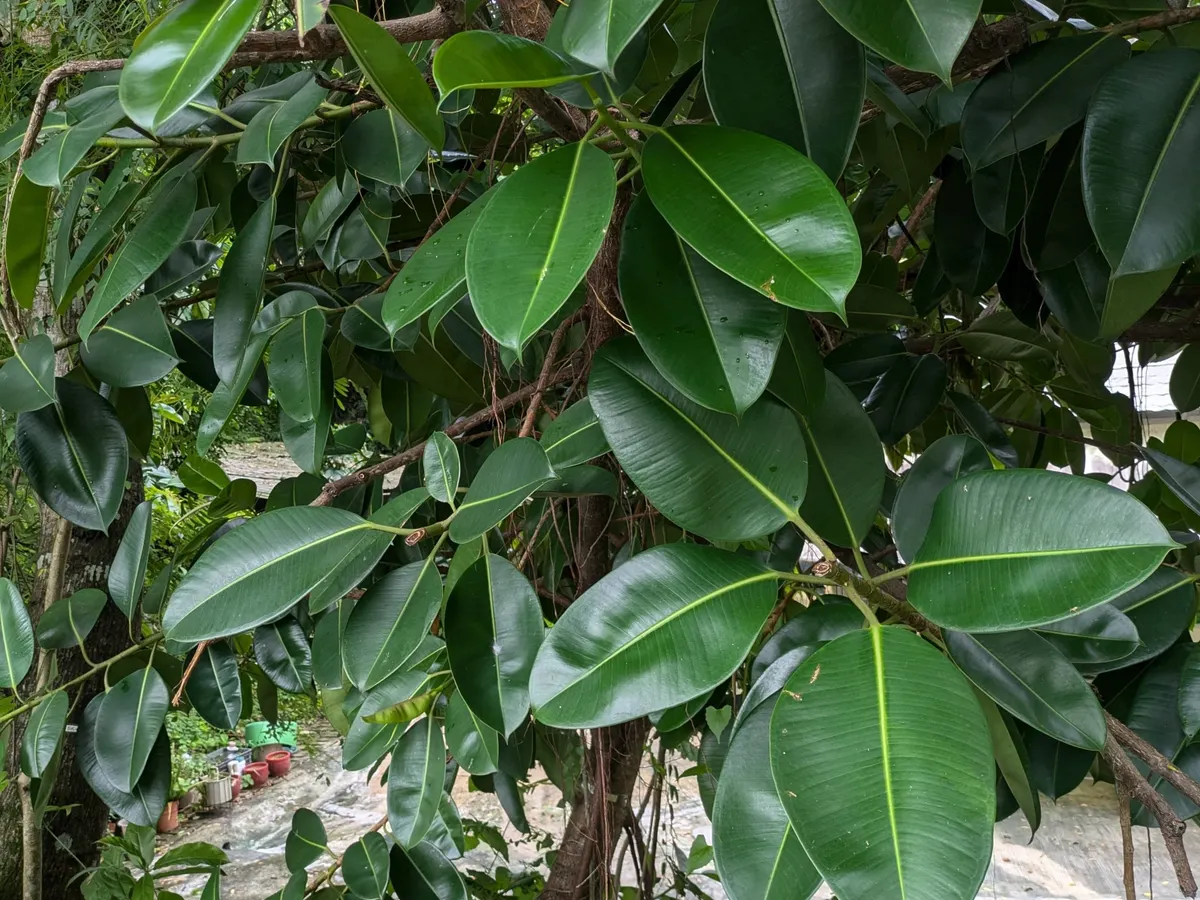
Photo: portioid, CC BY-SA 4.0, via Wikimedia Commons
- Light
- Bright, indirect · copes with less
- Water
- Water when the top 2–3 cm of soil are dry.
- Humidity
- Average
- Temperature
- 15–30 °C
- Care level
- Easy-going, a good first plant
- Pets
- Not safe for cats and dogs
How often to water Rubber plant
About every 8 days in summer and every 14 days in winter. Water when the top 2–3 cm of soil are dry.
Roughly how often, in a medium pot (12–20 cm) in the light it likes. Smaller pots, brighter spots and warm balconies need water sooner; big pots and dim corners later.
- Spring every 9 days
- Summer every 8 days
- Autumn every 11 days
- Winter every 14 days
Worked out by LeafMinder’s schedule. In the app it then adapts to your home, from your “still damp” and “bone dry” answers.
Feeding and repotting
Feed about every 30 days from March to September, with a houseplant fertiliser at half strength. Not in the colder months. Check whether it needs a bigger pot every 24 months or so, ideally in spring.
Thirsty, or too wet?
- When it would like water
- The leaves lose their shine, hang a little and may curl inwards, and the top few centimetres of soil are dry. A thorough drink perks it up within a day.
- When it has had too much
- Lower leaves turn yellow and fall, and the soil stays damp for days. Let the top 2–3 cm dry before the next watering, empty the saucer, and check the roots if leaves keep dropping.
Soil and pot
A soil-based houseplant mix with some perlite or bark suits it; it needs to drain well. Choose a sturdy pot with a drainage hole, heavy enough that a tall plant won't tip. Repot in spring every two years or so, one size up, when roots circle the bottom or grow out of the hole. Once it's as big as you want, just refresh the top few centimetres of soil instead.
Common problems
- Yellow leaves dropping from the bottom
- Soil kept too wet, or a cold spell. Losing the odd old lower leaf is normal. Try first: Let the top 2–3 cm dry between waterings and keep it in a stable spot above 15 °C, away from cold draughts.
- Leaves falling after a move or in winter
- Sudden changes in light or temperature, cold windows and draughts. Try first: Find a bright place away from doors and radiators and leave it there. It will settle and put out new leaves in spring.
- Tall, bare stem that leans
- Too little light: it grows towards the window and drops lower leaves. Try first: Give it more light and turn it now and then. For a bushier plant, cut the top back in spring just above a leaf; side shoots grow from below the cut.
- Dull, dusty leaves
- Dust settles on the big leaves and blocks light. Try first: Wipe the leaves gently with a damp cloth every few weeks. Skip leaf-shine products.
- Pale speckles, fine webbing or brown bumps under the leaves
- Spider mites, scale insects, mealybugs or thrips. Try first: Wipe both sides of the leaves, scrape off scale and repeat weekly until they're gone. Keep the plant apart from others meanwhile.
Not sure what you’re seeing? A photo health check suggests possible causes. How health checks work
Propagation
Air layering is the most reliable method at home, best in spring or summer. Remove a ring of bark on a stem about 30–45 cm below the tip, wrap the wound in moist sphagnum moss and clear plastic, and cut the new plant free once roots fill the moss, usually after several weeks. Tip cuttings 10–15 cm long also root in moist compost or water in warmth, more slowly. Wear gloves: the milky sap can irritate skin.
Varieties and relatives
- 'Robusta': The common form, with large, deep green leaves. Very sturdy.
- 'Burgundy': Leaves so dark they look almost black, with reddish new growth. Same care as the green form.
- 'Tineke': Green leaves marbled with cream and pale yellow. Needs a little more light to keep its colour.
- Fiddle-leaf fig (Ficus lyrata): A close relative with huge, wavy, violin-shaped leaves. More sensitive to moves and watering.
Questions people ask
How often should I water a rubber plant?
In a medium pot indoors, about every 9 days in spring, every 8 days in summer, every 11 days in autumn and every two weeks in winter. Water when the top 2–3 cm of soil are dry, and let the extra drain away.
Is a rubber plant toxic to cats and dogs?
Yes. The milky sap is irritating, and chewing the leaves can upset the mouth and stomach of cats and dogs. Keep it out of reach, and call your vet if a pet chews it. The sap can also irritate human skin.
How do I make my rubber plant bushier?
Cut the top of the main stem in spring, just above a leaf or node. One or more side shoots grow from below the cut. Keep the plant in good light so the new branches grow strong.
Should I clean my rubber plant's leaves?
Yes, it helps. Dust on the big leaves blocks light, so wipe them gently with a damp cloth every few weeks, supporting each leaf with your hand. Plain water is enough; skip oils and shine sprays.
From the journal
Sources and licences
This care guide was written with AI and checked against the sources below.
- Care checked against: NC State Extension Gardener Plant Toolbox, Iowa State University Extension and Outreach, New York Botanical Garden (NYBG) LuEsther T. Mertz Library, New York Botanical Garden (NYBG) LuEsther T. Mertz Library.
- GBIF Backbone Taxonomy: other botanical names. Record. CC BY 4.0. GBIF Secretariat (2023). GBIF Backbone Taxonomy. Checklist dataset https://doi.org/10.15468/39omei accessed via GBIF.org on 2026-11-15.
Material from these sources keeps its own licence; LeafMinder’s copyright doesn’t extend to it, and the sources don’t endorse LeafMinder.
General guidance. Every home is different, so the soil is always the best guide. About this advice
From LeafMinder’s plant care guides: leafminder.eu/plants/rubber-plant